No Philosophy, No Championship: The Real Reason NA Keeps Losing on the World Stage
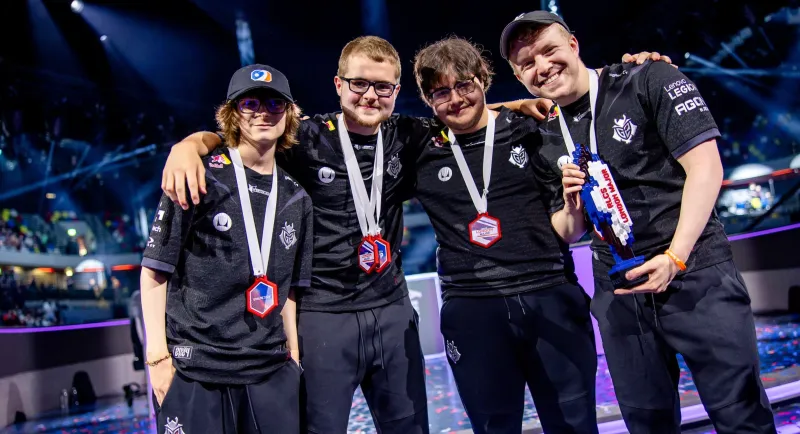
Photo: esports team strategy meeting Rocket League competitive tournament stage, via images.1v9.gg
Let's be honest about something that the NA Rocket League community has been dancing around for a few seasons now.
The players are there. The mechanics are there. The individual ceilings on rosters like NRG, G2, and the teams chasing them are genuinely world-class. On any given day, in any given series, an NA squad can beat anyone on the planet.
But "on any given day" is not a championship strategy. It's a lottery ticket. And NA has been buying lottery tickets while EU and SAM have been building systems.
The Oscillation Problem
If you've followed RLCS closely through 2024 and into 2025, you've watched NA teams do something that should be alarming: they keep switching identities mid-cycle.
A roster builds chemistry around a mechanical carry system — one player doing damage while two others rotate and clean up. It works for a regional. Then they face an EU team running tight rotation-first ball control, get exposed in the midfield, and the post-tournament conversation immediately pivots to "we need to play more like Europe."
So they adjust. They slow down. They try to build possession-based sequences. It works against domestic opponents who aren't prepared for the shift. Then they face a SAM team running aggressive pressure and get caught flat-footed because their spacing is now built for patience, not speed.
So they adjust again. Back toward individual expression. More mechanical freedom. More improvisation.
And the cycle repeats.
This isn't a talent problem. It's a philosophy problem. And it's been costing NA at Worlds for years.
What EU Teams Actually Do Differently
The narrative that European teams win through "better rotation" is technically true but misses the more important point. EU squads don't just rotate well — they build their entire team identity around a defined answer to the question: what do we do when we're not sure what to do?
Every team at the elite level faces moments of uncertainty. The ball takes a weird bounce. A rotation breaks down. A challenge gets lost. The question isn't whether those moments happen. It's what your team does by default when they do.
For most top EU squads, the default is clear: compress, reset, and rebuild possession. When in doubt, don't contest. Take the safe touch, cycle the boost, and force the opponent to make the first mistake. It's not flashy. It's not always exciting. But it's a defined answer that every player on the roster has internalized.
NA teams often don't have that answer. Or worse — different players on the same roster have different answers. One player's default is to challenge aggressively. Another's is to hold back and read. When uncertainty hits, they're not executing a shared philosophy. They're improvising individually. And three players improvising individually against a team running a coherent system is a mismatch that shows up on the scoreboard.
The SAM Comparison
South American teams present an interesting contrast because their dominant style — high-pressure, high-tempo, force-the-chaos — is actually philosophically closer to what NA wants to be than EU's possession game. But SAM executes it as a team identity, not as a collection of individual choices.
When a top SAM squad runs aggressive pressure, every player is committed to that pressure simultaneously. The spacing, the boost management, the rotation timing — it all assumes that everyone else is also pushing. The chaos is coordinated chaos. That's a completely different thing from three talented NA players each individually deciding to play aggressively in the same moment.
Coordinated chaos requires trust. Trust requires a shared philosophy. And a shared philosophy requires a coaching structure that actually enforces one.
The Roster Carousel Isn't Helping
NA's 2025 roster movement has been relentless. Several top teams entered the season with new configurations, new coaching staff, or both. From a raw talent perspective, many of these moves made sense on paper. But roster changes reset the philosophical foundation of a team, and in NA, that foundation was often thin to begin with.
You can't build a coherent team identity in six weeks before a regional. You can build mechanics. You can build communication habits. You can build individual chemistry. But the deep-wired answer to "what do we do when everything breaks down" takes months of shared practice to develop — and NA teams keep blowing up their rosters before that foundation can set.
Compare that to how EU's dominant squads have historically been built. The most successful European rosters in RLCS history have shared one thing: stability over time. Not necessarily the same five players for years, but a consistent philosophical core that new additions are integrated into, rather than a new identity assembled from scratch each cycle.
What a Real Fix Would Look Like
This isn't a call for NA to copy EU or SAM. That's exactly the wrong answer — and frankly, it's what NA teams keep doing wrong. Copying another region's philosophy without internalizing it produces a pale imitation that gets exposed immediately at international competition.
What NA needs is to choose an identity and commit to it completely. Not for a regional. Not for a split. For a full competitive cycle, with coaching infrastructure that holds the team accountable to that identity even when the short-term results suggest switching might be easier.
NA has the individual talent to make almost any system work. Mechanical carry? The players are there. Rotation-first possession? The IQ is there. Aggressive pressure? The speed is there. What's been missing is the organizational will to pick one and build around it long enough for it to become genuinely internalized.
The teams that win World Championships don't win because they're the most adaptable in the moment. They win because they're the most deeply committed to who they are — and that commitment makes them harder to prepare for, harder to read, and harder to beat when the series goes to overtime in a deciding game.
NA has the talent for a World Championship. It just needs to decide what it actually is before it can win one.
Until then, it's still buying lottery tickets.