Born in Freeplay: How Zen, ApparentlyJack, and the SSL Underground Are Inventing Mechanics Nobody Taught Them
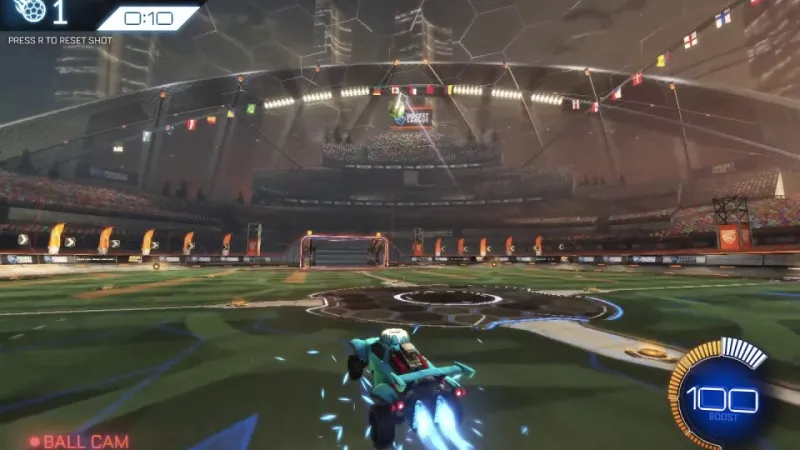
Photo: Rocket League freeplay arena solo practice aerial car mechanics, via i.ytimg.com
Every few months, something shows up in ranked lobbies that makes you pause the replay and watch it three more times. Not because it's flashy — though it usually is — but because you genuinely can't figure out how someone decided to try that in a live game.
 Photo: ApparentlyJack, via liquipedia.net
That feeling has a source. And it's almost never a training pack.
The mechanical ceiling in Rocket League keeps rising, and the players pushing it aren't doing it by grinding the same drill packs on repeat. They're doing it in freeplay — in unscripted, unstructured sandbox sessions where there's no correct answer and no failure state. That's where the real invention happens.
The Myth of the Training Pack Pipeline
Training packs are genuinely useful. Nobody's arguing otherwise. Shot practice, aerial consistency, speed flip timing — structured repetition builds the foundation. But there's a hard ceiling on what drill repetition can produce, and it's this: training packs can only teach you things someone already thought of.
Every pack is built around a pre-defined scenario with a correct output. You're training your hands to reproduce a known result. That's valuable for consistency. It's useless for discovery.
The mechanics that are redefining SSL lobbies in 2025 — the weird stall-to-air-dribble continuations, the ceiling-to-ground-carry hybrids, the off-axis flip reset reads that come from angles nobody practiced — those didn't exist in a pack. Someone found them by messing around with no particular goal in mind.
How Zen Built a Mechanical Language Nobody Else Speaks
Zen's mechanical style is one of the most immediately recognizable in NA right now. There's a looseness to it — an improvisational quality that looks almost accidental until you realize it's happening in the exact right moment, every time.
People who've watched his development closely point to extended freeplay sessions as the root of it. Not warm-up freeplay — the kind of five-minute bounce before a ranked session. Actual exploratory freeplay. Sessions where the goal is specifically to find something new rather than to execute something known.
The approach is closer to jazz improvisation than athletic drilling. You're not running scales. You're playing with the instrument until you find a phrase you've never heard before — and then you figure out when to use it.
Zen's signature stall reads, for example — the moments where he holds aerial position far longer than seems physically reasonable before committing to a touch — didn't come from a scenario pack. They came from repeatedly asking "what happens if I just... don't commit yet?" in a zero-consequence environment until the answer became instinctive.
ApparentlyJack and the Custom Map Frontier
ApparentlyJack's mechanical development story has a different texture. Where Zen's freeplay is more organic and drift-based, Jack's exploratory practice has leaned heavily into custom map environments — specifically maps designed to remove the standard arena constraints and force novel problem-solving.
Custom maps with modified ceiling heights, altered wall angles, or removed floor sections force your brain to stop relying on the spatial templates it's built up through standard play. You can't default to what you know because the environment doesn't match. That constraint produces creativity.
Several techniques in Jack's current repertoire — particularly his ceiling-to-wall transition reads that seem to defy normal car momentum — trace back to custom map sessions where the standard ceiling simply wasn't where his hands expected it to be. He had to find new solutions. Those solutions transferred back to the standard arena as novel mechanics.
Why Unstructured Practice Produces Mechanical Identity
There's something worth understanding about what freeplay actually does that drilling doesn't. When you run a training pack, you're reinforcing a specific neural pathway. The stimulus is fixed. The correct response is fixed. Repetition deepens the groove.
When you explore in freeplay with no defined correct answer, you're doing something different. You're building mechanical vocabulary — a broader set of motor patterns that your brain can draw on in live situations. The more varied your exploratory practice, the larger that vocabulary becomes. And a larger vocabulary means more options when the game presents you with a situation that doesn't match any drill you've run.
This is why SSL players can execute mechanics in the middle of a ranked game that they've "never practiced" — because they have. They just practiced them in a context without a defined correct output, so the skill looks unscripted. Because it is.
A Hybrid Framework for Your Own Mechanical Discovery
This isn't an argument for abandoning structured practice. It's an argument for balancing it with intentional exploration. Here's a framework that blends both:
The 70/30 Split: For every training session, spend roughly 70% on structured work — shot packs, specific mechanic drills, speed flip consistency. Reserve 30% for unstructured freeplay with a single loose prompt.
Give yourself a freeplay prompt, not a goal. "Find three different ways to continue an aerial after a wall touch" is a prompt. "Land five flip resets" is a goal. Prompts produce exploration. Goals produce repetition. You need both, but freeplay time should almost always be prompt-driven.
Record your freeplay sessions. This sounds tedious but it's genuinely valuable. You will accidentally stumble onto something interesting and completely forget it happened. Recording means you can go back and find those accidental discoveries before they disappear.
Steal from other games. Some of the most interesting mechanical ideas in Rocket League's current SSL meta came from players who asked "what if I tried the thing that works in [different scenario] here?" Cross-context thinking is a form of exploration. Don't limit your freeplay imagination to things you've seen in Rocket League.
Build a personal mechanic library. Once you find something interesting in freeplay, give it a name — even a dumb one — and spend two or three sessions just exploring that specific thing. You're not drilling it to consistency yet. You're understanding its shape. What setups produce it? What does it beat? When does it fail?
The Ceiling Nobody Can See
The mechanics that are going to define RLCS 2026 don't exist yet. They're being invented right now in freeplay lobbies by players who are messing around with no particular agenda.
That's the most exciting thing about Rocket League's mechanical ceiling — it genuinely doesn't have one. Every constraint people thought was final has been broken by someone who didn't know it was supposed to be a constraint.
Your next mechanical breakthrough probably isn't in a training pack. It's waiting in freeplay, in the moment you stop trying to execute something known and start asking what happens if you just try something weird.
Go find it.