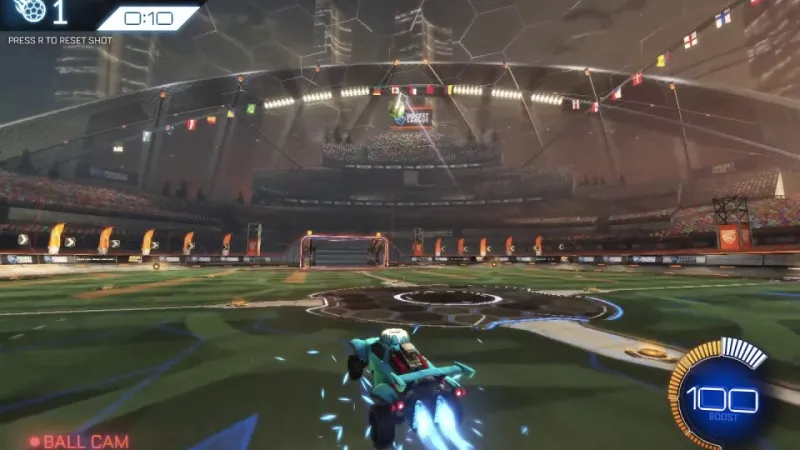
Kickoff as a Weapon: How NRG and G2 Are Stripping Boost Before the Ball Even Moves
Most players think about kickoffs in binary terms: you win it or you lose it. That framing is costing you games.
At the RLCS 2025 level — and increasingly in high-SSL ranked lobbies — kickoffs have become something more calculated than a 50/50 race to the ball. The best teams in North America are treating them as economic warfare. The goal isn't just to get a touch. It's to ensure that when the dust settles, your opponents are running on fumes.
This is the deadball economy. And if you're not thinking about it, you're already losing before the play starts.
What "Boost Denial" Actually Means at Kickoff
Boost denial isn't a new concept in Rocket League — passive players have been cutting boost pads in rotation for years. But what NRG and G2 have refined in 2025 is something more deliberate: pre-snap boost routing designed to starve opponents of their corner and mid pads before they can even establish rotation.
The principle is simple. Every player on the field has a boost economy to manage. If you can force your opponents into a situation where their second and third rotations happen at 30 boost or less, you've fundamentally altered what they can execute. Aerial challenges become tentative. Challenges that should happen don't. Rotations that should be aggressive turn passive.
The kickoff is the single moment in the game where positioning resets completely — and that reset is an opportunity to engineer a resource disadvantage from the jump.
The Three-Layer Kickoff Read
Watch NRG's kickoffs in their recent RLCS 2025 group stage matches and you'll notice a consistent pattern. Before the whistle, there's a pre-snap read happening at three layers simultaneously:
Layer 1 — Who's going? The kickoff attacker's path is chosen not just based on speed, but based on which diagonal boost pad they can clip on the way in. The standard diagonal approach to a center kickoff isn't just about angle — it's about whether the attacker can vacuum the large corner boost on the near side while still contesting.
Layer 2 — What are the backfield players doing? This is where most players at Diamond and below completely check out. While the kickoff is live, the two non-kicking players aren't just waiting for the result. They're reading the opponent's kickoff formation to predict which boost pads will be contested and which will be left unguarded. A backfield player who sees both opponents commit forward knows to sweep the mid boost pads aggressively.
Layer 3 — What's the fallback? Elite teams have a pre-agreed answer to every kickoff outcome. If we lose the 50, where is the ball likely to go, and who already has the boost to challenge it? The team that has 100 boost ready for the second touch almost always wins the exchange.
Frame-by-Frame: The G2 Kickoff Pattern
In G2's match against a top EU seed during the recent RLCS 2025 regional, there's a sequence worth dissecting. On a diagonal kickoff, G2's attacker takes a slightly wider arc than necessary — not because it's faster, but because it allows them to clip the large boost pad on the left side of the field before the contest.
Simultaneously, the right-side backfield player doesn't hold position. They sweep inward immediately, collecting both mid boost pads (12 boost each) while the opponent's right-side player holds back defensively. By the time the kickoff resolves — even as a neutral bounce — G2 has collected an extra 64 boost across the team. Their opponents haven't touched a pad.
That's not luck. That's a designed play.
The opponent now has to challenge the second touch from a deficit. One player is at 0 boost from the kickoff. The other two are at whatever they spawned with minus their kickoff approach. G2 is already controlling the tempo.
How to Apply This in Ranked
You don't need to be on a pro roster to start implementing boost denial logic into your kickoffs. Here's a practical framework:
Start with the diagonal sweep. On any diagonal kickoff, consciously route your approach through the large corner boost on your near side. Yes, it costs you a fraction of a second. But you're entering the play with full boost instead of whatever you spawned with, and you're denying that pad to any opponent rotating through that zone.
Train your non-kicking players to sweep mid. This is the biggest missed opportunity in ranked games below Champion. The two players not going for the kickoff should be moving — reading whether the opponent is committing both players forward, and if so, sweeping the mid pads aggressively. Even in solo queue, you can build this habit for yourself.
Stop holding at your own boost. Holding at your large corner boost during a kickoff is a passive habit that feels safe but surrenders map control. If you're not the kicker, you should almost always be moving — either toward mid pads or into a position that reads the kickoff result and responds immediately.
Pre-read the formation. Before the whistle, look at where your opponents are positioned. Two players pushed far up means they're both committing. One player held back means they have a safety net. Adjust your backfield behavior accordingly.
The Meta Shift Nobody's Talking About
What makes this particularly relevant in 2025 is how RLCS teams are adapting their overall game plans around early-possession boost advantages. Teams that win the boost economy in the first 10 seconds of a play tend to force longer possessions, which compounds pressure. Opponents without boost can't challenge aerial carries. They can't contest 50/50s at full speed. They're making reactive decisions instead of proactive ones.
The kickoff used to be a formality. Now it's the opening move in a resource management game that runs the entire length of the match.
If you're still treating kickoffs as a coin flip, you're playing a different game than the players above you. Start engineering the economy from the first whistle — and watch how much easier everything that follows becomes.